The North Watch: Adventures in the Narumbeki Gap
A Southlands Sandbox.

Chapter Two: The Lion Road:
Introduction
T’Balla muses out loud, as he is wont to do, “Some say the Gods are life. Some say water is life. Here, I say, the Lion Road is life. You and your caravans are the lifeblood of the Road. The captain and the Shields of the North Watch, and their brethren to the south, protect the body of the Road. We, of the Wondrous Vista, feed and nourish the soul of the Road. For if you are not able to look forward to a fine meal or a soft bed as the sun sets, then life on the Road is not worth living!”
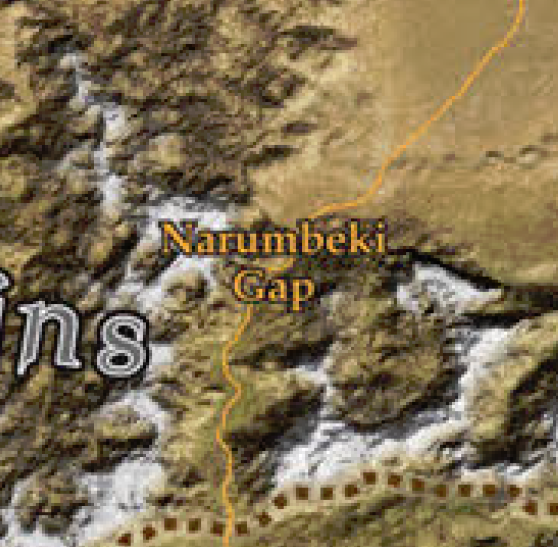
The Lion Road stretches for many hundreds of miles from Nuria Natal south to Narumbeki. This series of articles considers the approximately three hundred mile stretch centered upon the keep at North Watch, the northern end of the Narumbeki gap. The lands about the northern half of the road are mostly uninhabited and subject to the hazardous weather and creatures of the plains. The lands around the southern leg are lightly inhabited, most of the population in a number of settlements along the road, but also subject to dangerous weather (especially in winter) and monstrous attacks (at other times of the year).
Geography (Physical and Political)
Typically T'Balla can be found at sunrise on the porch of the Wondrous Vista looking to the north where with arms spread wide he frequently expounds upon the local beauty, "Favored guests," he usually exclaims to those who happen by, "Is this view not like the edge of the world? Here we are protected by the broad white-cloaked shoulders of the mountain titans who surround us. They look down upon us, their tiny minions, living about their feet on their trouser slopes and shoe tops of green grasses, festooned with brush of holly and tree of pine. Trickles of water, shrugged from their raiment by the light of the sun, trace narrow runs between the vast peaks. But there," he points north, "is like a different world. Young peaks, smaller than the titans, hot and smoky, full of the fire of youth. And over there, the wide flat barrens ruled by the driving winds and drifting sands."
In the surrounds of North Watch, the Lion Road crosses three very different areas of terrain. The northern third is a crossing of the dry wastes of southern Nuria Natal. Flat land, dotted with scrub brush and rocky outcroppings, stretches as far as the eye can see. The volcanic mounts of the Fassili mountains to the west spawn periodic bursts of hot wind that races across the landscape.
The foothills of the MBazha mountains begin with an escarpment upwards of a hundred feet high in places, stretching from the slopes of Fassili to points further east. At the top of the ridge, the weather cools noticeably, grows moist and fosters the growth of a carpet of green upon the foothills. The middle third of the highway ascends the hills, switching back and forth on the steeper slopes as the MBazha’s snow-clad summits fill the horizon.
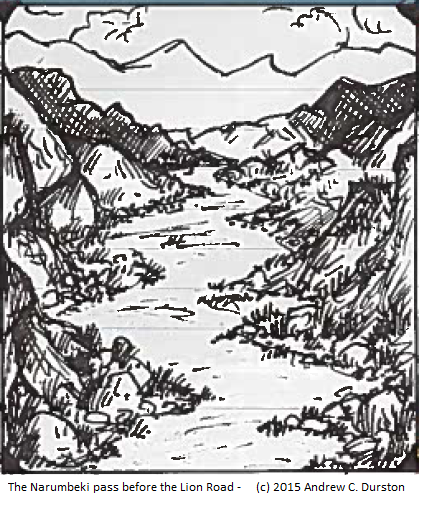
Once past North Watch, the Lion Road enters the Narumbeki gap proper and winds directly south through mountain valleys. The land is high, the air is thin and the slopes covered with ancient Alpine forests. Above the treeline, the taller peaks are covered with snow throughout the year. Narrow mountain streams cut across or parallel the Lion Road. A number join to form Valley Lake near the southern border of the Gap. The south end of the Gap is marked by South Watch, a settlement and fortress similar in appearance to North Watch, but home to a rather different population.
Weather in the Gap
As the terrain along the Lion Road is of two main sorts, the barrens and the mountains, the weather mirrors those two locales. The weather north of North Watch, especially once past the ridge at the Great Lift, is typical of the northern deserts. The weather in the Narumbeki Gap is typical of alpine mountain ranges with short pleasant summers and harsh snowy winters. The locals are quite adept at predicting the potential for winter storms thus the experienced caravan masters play close attention to their words.
Culture of the Gap
Although the Narumbeki Gap is north of Narumbeki’s northern border, the locals generally follow the rules and traditions of their brethren to the south. Each settlement is run by a council of elder or important peoples, usually the notable merchants or crafters. But all defer to the town’s Captain (who leads all trained locals of Narum descent as the town’s guard) in matters of conflict, crime or defense. In the larger settlements, such as North Watch, the Captain’s command is of typical size. Smaller thorps may only be able to muster a Shield or two.
Locations of Note
T’Balla advises a traveler from Nuria Natal who is new to the Narumbeki gap, "You have reached the gates of civilization at last! The rest of your journey shall feature rooms with roofs and underneath in some cases fair accommodations. Each about a day's travel from the last. If the weather turns foul, be sure not to dawdle. In fact, I may humbly say that the rooms of our fellows at the distant South Watch might even been considered to be equivalent to those of the Wondrous Vista, if," he smiles, leans close with a conspiratorial wink, "You squint and hold your nose. Ha ha ha." A grand guffaw bursts out from the ebullient elder statesman of the Gap.
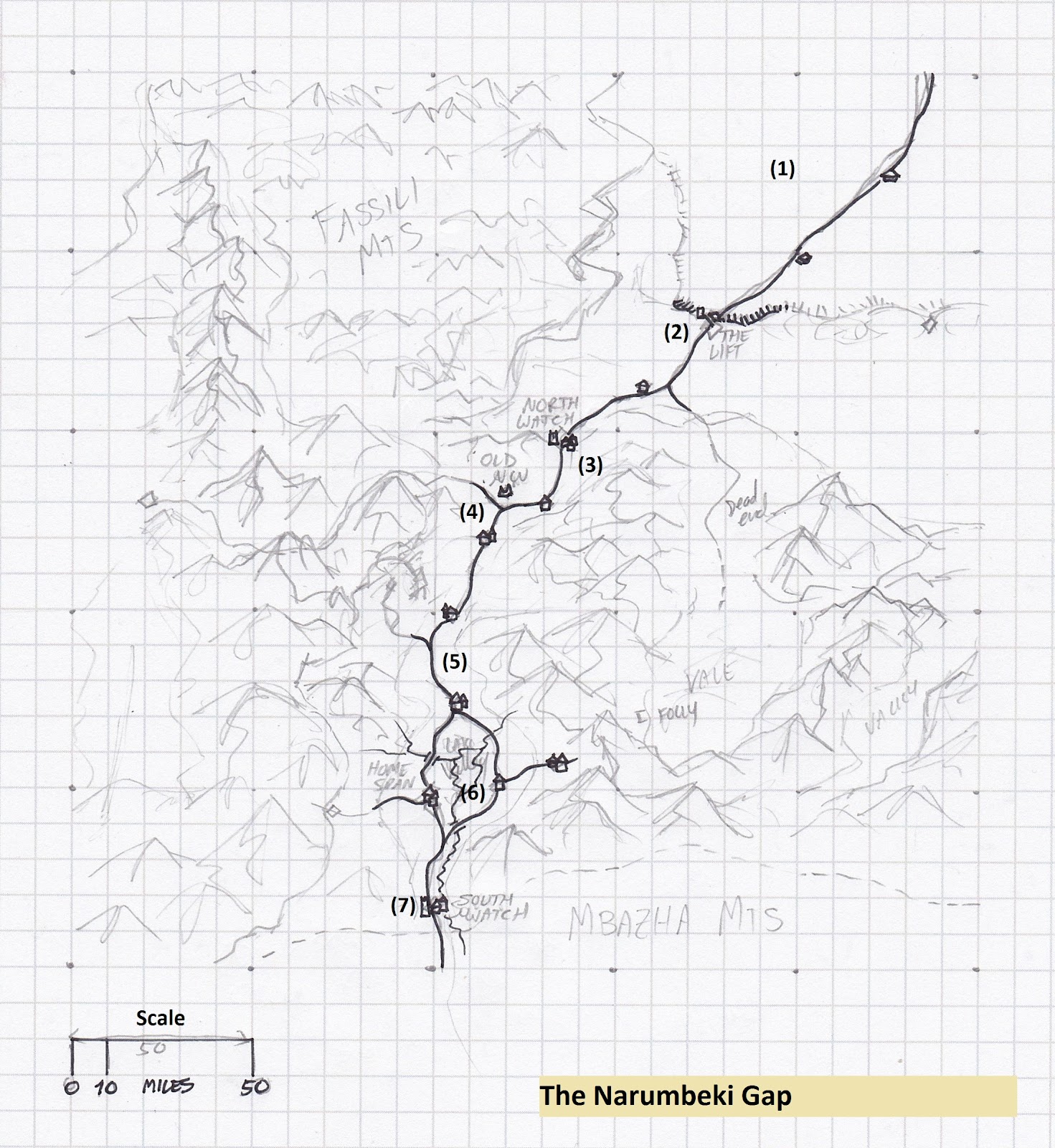
The following are locations of note along the Lion Road from northeast to the south.
- The Barrens
- The Great Lift
- North Watch
- Old North Watch
- Villages
- Cold Lake
- South Watch
The Barrens:
The Lion Road crosses hundreds of miles of barren wastes between the oasis at Qitta and the Narumbeki Gap. Although there are no settlements along the way, at the end of every day of travel, caravans camp at frequently used caravansaries . These areas have been cleared of debris and hazards. Some feature areas enclosed by wooden fence or low stone wall for corralling mounts. One or two feature trails to nearby springs (which themselves can be hazardous as the water attracts predators who might see travelers as prey). Others may be deep wells or troughs and cisterns that can be filled by spell that summon water or food.
The Great Lift:
Southwest of the wastes,against the escarpment that runs from the Fassili mountains eastward, is the Ara Nui (the Great Lift), a clockwork and beast-powered contraption that can lift several wagons at a time up the side of the ridge. Built many years ago by the Dwarves of Sebbek Sobor and maintained by the caravan masters of Nuria Natal, the elevator saves at least a day of travel on the route south. The Great Lift is the second such construction. Nearby is the original elevator, now called the Little Lift, whose capacity is a single wagon or several horses.
North Watch:
Two days southwest of Ara Nui, the road climbs the foothills to reach the fortress and village of North Watch, the north end of the Narumbeki Gap. The keep at North Watch rises over the road, with a view that extends far into the wastes. It is commanded by Teni Chike Mphikeleli. Upon the roofs are seige machines which can throw bolts or stones at raiders or intruders several hundred yards away. Across the Lion Road is the sprawling Wha’kam’haro Tiro (Wondrous View or Vista) Inn. Owned by the M’Bassu family of Narumbeki for centuries, the Wondrous Vista provides excellent accommodations for all manner of travelers. The village of North Watch surrounds the Inn, featuring several general stores, a smithy (run by Hargen Blackhands), cartwright (home to Hastain the minotaur ), ostler and several taverns. Beyond the surrounding stone wall, typical of Kraals to the south, are the Caravan yards, fields divided by fences, marked with the name and device of the owning caravan master. Some areas are rented or shared by several caravans.
Old North Watch:
About a day and half west of North Watch is a ruined tower known as Old North Watch. Built in the early years of the Lion Road, Old North Watch fell victim to a prodigious run of bad luck including raids, disease, avalanche and finally a landslide which carried away most of the surrounding village. Old North Watch was abandoned and soon after North Watch was established. The wilderness now works to reclaim the ruins. Birds nest in the single tower that remains, creatures have dug lairs in the cellars.
Villages:
Strung along the Lion Road, like lanterns on a rope, are a number of small settlements hugging the highway from North Watch to South Watch. Each, built in the style of the Narumbeki Kraal, are home to perhaps 100 to 200 souls and usually feature a large Inn or two, surrounded by various homes and businesses, enclosed in a palisade of wood or a wall of stone. A single tower, usually the tallest structure in the thorp, houses the Captain of the Village Watch and his or her command (one to two Shields of warriors plus others such as weaponsmiths, healers, scouts or minor magicians).
Cold Lake:
A day’s ride north of South Watch is the Matao (Cold) Lake, formed by runoff from the snows of surrounding mountains. The Lion Road runs about the west side of the Lake. Locals have built a spur connecting several settlements on the east side. The Lake, whose depth is unknown but suspected to be quite deep, empties at its south end into a creek that flows to the Narumbeki plains. Cold Lake’s water is clear and crisp, home to a variety of fish and wildlife.
South Watch:
The Lion Road exits the Narumbeki Gap at South Watch, a village superficially similar to North Watch with a large keep and a notable Hotel. The hotel owner fosters a friendly rivalry with T’Balla of North Watch, despite the fact or perhaps because of the fact that they are likely related.
The Form of the Road
The construction of the Lion Road varies throughout its length, from as simple as a broad, cleared well-traveled path of packed earth, to an elaborate construction with drainage, curbs and a solid surface. In the wastes, north of North Watch, the road winds as needed to avoid large obstacles but is generally straight. Within the Narumbeki Gap, the road follows the path of the valley floors between the mountains, with cuts and fills as required to pass through ridges or over ravines. The road surface is of fitted stone on top of roadbed featuring layers of packed earth, gravel and crushed stone. Drainage channels were dug along both sides, where possible, streams pass underneath by culverts or pipes. The sides of the road are contained by curbs of stone.The dwarves of Sebbek Sobor crafted several well-reinforced tunnels and a number of elegant but strong white stone bridges along the way. Along the road, between towns, the locals have built a number of long wooden shelters, large enough for teams and wagon to park side by side, designed to provide minimal shelter versus snow storm or even avalanche (given enough warning). On several of the steeper slopes, before sharp curves, short ramps run up the hillside. Drivers, unlucky enough to be on a runaway cart, have a change to steer onto the ramp and come to a sudden stop rather than pitch off the side of the mountains further downhill.
Micromap Mini-settings
Roaming the Prairies: The Little Lift - at the escarpment northeast of North Watch

As the Lion Road road nears the MBahza Mountains, a ridge cuts across the landscape from west to east. Originally the road detoured, adding a day or more of travel, along the face of the ridge until it could ascend. Years ago, the Dwarves of Sebbek Sobor heard of complaints about the delay from various merchants of their allies in Narumbeki.
The Dwarves sent a number of engineers (with a goodly train of guards and provisions) north through the Narumbeki Gap. At the ridge, they undertook construction of a mechanical lift to raise wagons up the 100 foot rise. The first lift was small, carrying a single vehicle at a time, but was quite successful.
The Dwarves resupplied and over time engineered the Great Lift, which could carry 3-4 wagons at a time. The original lift, still in operation to this day, was nicknamed the Little Lift. Small caravans or groups of horsemen use it while larger groups are lifted nearby.
The Little Lift is a 20 foot by 20 foot platform, raised by winches (wound by oxen or groups of slaves) assisted by counter-weights. The mechanisms can be run from bottom or top, contained within circular huts with metal roofs. At the top the ramp can be locked in place for loading and unloading.
Climbing the Mountains: Homespan - along the Lion Road south of North Watch.

As the years passed after the Lion Road was established, caravan masters and local merchants worked together to maintain and optimize the highway. In the long valley north of South Watch, they surveyed a change in route that required a bridge over a mountain stream flowing east into Cold Lake.
Dwarf engineers, from Sebbek Sobor, were hired to survey the site accompanied by several Shields of Narumbeki warriors from South Watch. Unfortunately the best site for the span also happened to be the home to a rather large and dangerous mountain troll. The warriors prepared to engage the monster in combat, but the dwarves had a better idea.
They sent their largest and most fearless engineer, with a mule laden with casks, to carefully approach where the troll appeared to reside further upstream. With some rather careful but loud negotiation, they reached an agreement.
Over the next several years, the dwarves built the span across the river with an unusual feature. in the center of the north end of the bridge, 70 or so feet below the top of the bridge along the riverbed, was a large 6 foot wide, 15 foot tall door. It opened into hall leading to a simple, but large 20 foot square, 25 foot tall chamber carved into the mountain which the troll could call home.
In the years since its construction, that troll has made the site his (or her?) home, expanding the chamber into the heart of the mountain. Its presence has had an added benefit of driving away other less tractable intruders. The locals have nicknamed the bridge the Homespan.
History
T’Balla escorts his guests to a small garden at the edge of cliff on the north side of the Wondrous Vista. In the center of the garden, hidden from view by waist-high hedges, is a large square block of stone carved with a single symbol on two sides. "Almost a thousand years ago, give or take some lost to the counting of time, my blessed ancestors came to this spot. Here they placed the Toh'ware, the stone symbol of our family and declared that we shall stay until the time comes that our gardens are salted and our Toh'ware is captured, crushed or soaked with our blood." He puffs up his chest, "And we have proudly done such. The Wondrous Vista still stands today and is always open for business."
History Past
Nuria Natal was established years before Narumbeki. During that time Nurian explorers found and mapped a number of passes across the MBazha mountains that divide the Southlands between north and south. Adventurers found the lands to the south rich in resources but devoid of nations. Trade was limited to exchanges with a few friendly tribes and clans. The eastern routes, trading with the dwarves of Sebbek Sobor and others, were more profitable.
The trade route, following the westernmost of the previously mapped passes, was established when the Narumbeki nation came into being. As the route was used, the settlements of the Gap were built in response to the needs of the caravans and the armed in response to raids out of the east. Locals, funded by merchant companies, built the keeps at North Watch and South Watch. Caravan companies hired dwarven engineers (of Sebbek Sobor initially and now from western Narumbeki) to clear the landscape, raise the roadbed, provide drainage and build bridges as needed across the valleys of the Narumbeki Gap. Well before the route was complete, it had been dubbed the Lion Road.
Timeline
- Approximately 3000 years ago - Warrior tribes, once beloved of the Titan Mwari, settle on the plains south of the MBaka mountains
- 2500 years ago - Now a unified nation, merchants of Nuria Natal establish contact with the Mukani (warlord) of Narumbeki
- 2200 years ago - the final path of the Lion Road is established. The route is named in honor of the current Mukani
- 2000 years ago - keep at Old North Watch established
- 1800 years ago - keep abandoned, North Watch proper established nearby
- Approximately 900 years ago - the Wondrous Vista Inn opens in North Watch
The Gap Now
Narumbeki patrols (a Shield or half-Shield ) only about 1/2 day to a full day beyond their border (to South Watch and back home)
Narumbeki Shields may accompany caravans of Sobor or Narumbeki origin. Most Shields usually stop at North Watch, rest and return. Some have been known to go all the way to Nuria itself (but is an unusual circumstance usually dictated by the cargo being carried).
Inhabitants and Notable Persons
“Yes yes,” T’Balla nods in response, “We of the North Watch are the salt of the earth. Wonderful friendly sorts, helpful in all manner of things. Our great Teni, Chike, and his shields do an excellent job of protecting the walls and those of us within. Inside the walls, fine craftsmen and women, such as Hargen the Smith and Hastain the Cartwright, serve all of who pass through. Walk about, look and see, and you shall agree. No finer stop on all of the Lion Road!”
Captain (Teni) of North Watch, his/her staff, family and command
Teni Chike Mphikeleli is a male Narumbeki warrior of middle age [LG Hero level, warrior]. His face bears the scars of several battles and his demeanor is that of one who has seen death and destruction and will discipline his warriors so that they will stay alive. Chike has a softer side which he only displays to his wife and daughter. His wife, Nduduzo, is the herbalist/healer [NG IF level] for her husband’s company of soldiers. She is adept at casting incantations and rumors abound of some of the blood incantations she may have used to help save her husband from certain death. Their daughter, Thoko, named for the happiness that she brought her parents, is only six years old. The couple had thought they were not meant to have children and so were willing to take on more life-threatening missions when during their last battle, Nduduzo saw a flash of bright light coming from her belly just after she performed a ritual incantation. A few days later she discovered she was pregnant and her husband was promoted to his current position.
One of Chike favored companions is the dwarf Ntanga Magron Battleroar. [LN IF level, warrior] Magron has attached himself to the Chike’s company with the approval of the government of Sebbek Sobor. Magron is treated as if he were Chike’s younger brother. Magron will occasionally act as a liaison for Sebbek Sobor with the Narumbeki shields of the Gap. Magron is typical of most dwarves from Sebbek and is a skilled warrior in his own right. Instead of wearing typical dwarven armor, Magron has pieced together his own unique set, comprised of pieces of Narumbeki zebra armor and dwarven heavy chain. Chike and Nduduzo include Magron in all holiday celebrations and family gatherings.
Nduduzo’s brother Gibeli is part of the Imbangala, the zebra mounted cavalry casters. [Hero level, magician] He is not officially attached to Chike’s company but; instead will spend his off hours with the family when he is stationed nearby. Gibeli is quite a bit taller than Nduduzo and has an intimidating presence, especially when riled up. His dark eyes and mohawk-styled hair stand out in battle and he often braids his zebra’s tail to match his mohawk.
T’Balla,his family and staff of the Wondrous Vista
T’Balla M’Bassu is the proprietor of the Wondrous Vista Inn and the latest scion of the unbroken line of the M’Bassu (Sons of the Lion) family dating back almost a millenia. [CG IF level, non-profession/merchant] T’Balla is broad and thick human male, a bit above average height and well above average weight. His once well-muscled arms are a bit softer now but stir bare the scars of his service in the shields. T’Balla is a boisterous and talkative fellow, his booming voice frequently heard through all the halls of the inn, usually telling a grand tale of the surrounds.
T’Balla is a widower, his wife passed away 10 winters ago. He is assisted by two of his sons, Hantal and G’Zal, their wives and childen. Hantal, the elder by several years, will inherit the Vista eventually, but T’Balla shows no signs of slowing down. The staff of the Inn consists of another half-dozen men and women, most of Narumbeki descent. All are capable of taking up arms in defense of North Watch.
An almost permanent resident of the inn is a human, Thorne Redwood. [NE IF level, scholar/assassin] He is a trader of magic scrolls from city of Lignas. He often makes several hundred gold on just one scroll so he has found no reason to set up a storefront. Thorne is in his early forties, has pasty white skin and dark, almost black eyes which seem to be always watching. His gaunt appearance would make him almost frightening to behold if it weren’t for the fact that he wears bright, garish outfits. One would be wise to take him seriously though, as he is secretly an agent of the Coil of Memory. His main responsibility to that agency is investigating potentially talented spell casters as they come through the area. Currently, no one suspects his true purpose at the inn and most casters are just happy to have access to rare scrolls.
Ironmonger/Ambassador
Hargen Blackhands the Metalsmith is a dwarf refugee from the collapse of Haldaheim who didn't make it as far as Sebbek Sobor. [N IF level, crafter/blacksmith] He was enthralled by the view from the Wondrous Vista and made a home in North Watch. Aside from being a skilled blacksmith and ironmonger, Hargen also serves a point of contact between merchants and several local communities of dwarves living in the MBazha mountains to the west. Hargen was nicknamed Blackhands not for any particular act but as his hands are thick and black with soot and metal flakes from years at a forge without gloves (Hargen says "Bah, no feel for the metal through the gloves. You have to sense the changes in the steel by your bare hands, big nose and a good ear.") Hargen and Magron can frequently found together at the bar of the Wondrous Vista.
Cartwright
Frequently found lifting wagons by himself, or assisting Hargen with larger projects, is the minotaur male Hastain, the cartwright of North Watch. Hastain has lived in the town for almost ten years now, having travelled from the south to apprentice with the prior cartwright, who passed away several years ago. He is a tall and quiet fellow of gray-brown fur, steel-gray horns and prodigious strength.
Aside from working with the local caravan masters, Hastain assists Hargen with maintaining a series of tunnels under North Watch. Delved many years ago, the tunnels connect the Keep with the Wondrous Vista, provide storage for both in time of siege and two escape routes. One leads south exiting outside of the town’s wall near a stream. The other heads north and descends the ridge to exit near where the Lion Road descends into the foot hills.
Caravans of Note
Caravans that regularly run the Lion Road range from small and quick to large and plodding. Below are a couple examples of the “regulars.”
Tinkers: Evers and Chance
Evers, a dwarf man, and Chance, a human woman, once were competing tinkers in Per-Xor. Rather than run each other to ruin, they decided to join forces. The Tinkers spend the cold months in Nuria-Natal. When spring nears its peak, they pack up their two heavily built and very complex tinker wagons, lash them to large draft oxen and head south. Evers and Chance spend the summer selling tools and fixing devices in and about northern Narumbeki villages before returning north in the fall.
Abduhl Arrantir of the Wastes
The Arrantir family of Nuria has organized and sponsored caravans to Narumbeki for over 200 years. Abduhl, at a relatively young mid-20s, is the latest in the line of verbose and flamboyant caravan masters. Famous for his frequent changes of clothes, those outfits full of colourful scarves, ribbons and jewelry, Abduhl is a quick-witted businessman with a notable temper (common to the men in his tribe).
The Arrantir caravan usually numbers 20-30 wagons and carts, numbering well over 100 persons including drivers, guards, guides, workers and numerous passengers traveling in colorful and ornate carriages (in the well defended center of the train).
Races of the Gap:
The distribution of races found in the settlements along the Lion Road resemble that of the connected nations, Narumbeki and Nuria Natal. However given the small total population, the proportions don’t follow the same percentages you might expect.
70% Humans, 10% Dwarves, 10% Gnolls, 4% Minotaurs, 4% Heru, 2% other races.
Note: In order to allow for flexibility and scaling for the power-level of a campaign, NPC levels are given in generic categories, specifically (from lowest level to highest):
- Ordinary Folk (OF) - the bulk of the population
- Important Folk (IF) - the top few % of the population
- Heroes (H) (and/or Villains (V)) - NPCs well above ordinary, notable in their region
- Epic Heroes (EH) (and/or Epic Villains (EV)) - the best of the best (or worst of the worst)
- Herein be Demi-Gods and the Gods
Encounter Tables:
Along the Lion Road and up to a 1/2 days travel (~10 miles) on either side. (For areas further afield, see the next chapters.) Suggest an encounter roll for each 4 hours of day or 10 miles of travel.
1d100 Dice Roll
|
Encounter
|
Notes
|
01 - 30
|
Wildlife/Animals
|
Hills/Wastes north of North Watch
Alpine/Mountains south of North Watch
|
31 - 50
|
Wildlife/Monster
|
Hills/Wastes north of North Watch
Alpine/Mountains south of North Watch
|
51 - 60
|
Terrain
|
Sinkhole, landslide, ravine or other unusual feature
|
61 - 70
|
Weather
|
Avalanches, snow squalls and other harsh winter weather are common along the Lion Road’s southern section, especially in winter.
Flash floods or mudslides in spring.
Hot windstorms out of the Fassilli mountains in the summer.
|
71 - 80
|
Caravan
|
Traveling either direction. Usually consists of 10+1d10 wagons/carts (pulled by 2-4 animals each) with 2-4 drivers/guards/workers per wagon plus 1d20 passengers and 1d10 additional guards or notables.
|
81 - 85
|
Patrol
|
1-75 A Shield lead by a Ntanga (Lieutenant) on a walk-about patrol from the nearest village.
76-100 A Company lead by a Teni (Captain) from Narumbeki proper (if within 10 miles of South Watch)
|
86 - 90
|
Messengers/Lone Riders
|
Single mount and rider of any race headed north (1-3 on a d6) or south (4-6 on a d6)
|
91 - 95
|
Bandits
|
6+1d6 OF level Fighters lead by 1 IF level Leader attack via ambush (1-75) or direct attack (76-100)
|
96 - 98
|
Kushian Raiders
|
1d6 IF level Agents of the Jade, human, humanoid or not quite human anymore.
|
99 - 100
|
Special
|
GM Choice
|
Adventure Threads
About the fireplace, as the winds of winter howl outside held at bay by strong wood and thick glass, T'Balla addresses a group of young would-be warriors, "Yes, yes, the Lion Road and the walls of our Kralls are the safest places of the Narumbeki Gap. The reward for adventure comes hand in hand with equal risk. There are usually caravans who seek sturdy shields to accompany their wares as they head both north and south. There those who seek swords for less savory endeavors usually beyond the protection of our walls and shields and away from the clear line of sight of the road. Rumors of lairs - creatures who have created homes for themselves or taken the place of others and hunt from there. Rumors of intruders - usually the spawn of the Green Walker but sometimes lesser bandits. Ask yourselves, do you seek the test of the sword or the test of the shield?"
Similar to NPC levels, adventure difficulties are defined as
- OF - for Ordinary Folk/beginning adventurers
- IF - for Important level Folk/intermediate adventurers
- H - for Heroes/experienced adventurers
- and EH for truly Epic Heroes/veteran adventurers.
Sample adventure threads for the Lion Road portion of the Narumbeki Gap region:
- [OF] The captain asks you to journey from North Watch to Old North Watch to assist with the first passage of a novice caravan-master who appears to have run into a spot of trouble.
- [IF] Noted caravan-master Abduhl Arrantir seeks your help securing the materials to craft a unique weapon in order to impress a Narumbeki shield-maiden, A’Rea.
- [IF] A noble of Nuria Natal contracts you to escort a high value caravan from North to South Watch. She has received a vision that minions of the Green Walker seek her cargo.
- [H] A survivor arrives from the north to report that well-armed bandits have seized the area around the Great and Little Lifts. You are asked to join the Captain and several Shields on an expedition to drive them away
- [EH] The Green Walker attempts to close the Gap by seizing South Watch. A tendril has infected the Mountain Troll under Homespan bridge. It now leads a horde of minions of who have seized the southern town and infected the surviving locals.
Coming soon: Chapter Three - The Greening Hills